At the intersection of economics and sociology. As a researcher, entrepreneur and consultant.
How does innovation emerge in organisations — and why does it fail? 70+ interviews, longitudinal studies, no buzzwords.
From practice to theory, never the other way around. The bridge between academic knowledge and real-world application.
With evoplan Consulting — close to practice, firmly grounded in theory. Strategy, innovation, organisational development.
Economist and sociologist. Researcher, entrepreneur and consultant at the intersection of academic knowledge and practice.
I combine economic and sociological thinking — as a researcher, entrepreneur and consultant. Many consultants think sociologically but not economically. Many economists think in models but not in social realities. Strategic thinking needs both — the combination is rare and decisive.
For family businesses and the Mittelstand, this means: strategy is my core field — with an eye for what numbers cannot show.
My academic approach draws on American Pragmatism — Dewey, Mead, James. Theory is not an end in itself, but a tool that must prove itself in practice. My theoretical foundation is Friedrich Fürstenberg's tension field approach: organisations are living tension fields between individual needs and institutional demands — between autonomy and control, efficiency and legitimation.
Diplom-Volkswirt (University of Bonn) · Dr. phil. · MBA studies (Copenhagen Business School). Founder and Managing Director of evoplan Consulting. Over two decades of experience in consulting, research and teaching. Guest professor at Hochschule Darmstadt, Hessian Higher Education Prize for Excellence in Teaching 2024, VCI Science Prize.
From practice to theory — never the other way around.
2009–2018
70+ Interviews
Grounded Theory · 7 sites
Q: How is innovation anchored — or why does it fail?
F: Multidimensional model. Nomos 2019, VCI Prize.
2018–2023
25+ Interviews
Guided interviews
Q: How does digitalisation change culture and leadership?
F: Tension fields between modernisation and inertia.
2024–2025
Scientific Advisor
Leadership responsibility
Q: How can a new unit be built successfully?
F: Insights on change — connected to the tension field approach.
Individual freedom of action meets organisational governance requirements.
Economic rationality meets social acceptance requirements.
Personal needs meet structural constraints and expectations.
Innovation pressure meets organisational inertia.
Organisations are not machines. They are living tension fields — between individual needs and institutional demands. Between autonomy and control. Between efficiency and legitimation. Friedrich Fürstenberg was the first to describe this insight systematically. I carry it forward.
The approach combines economic thinking with sociological understanding — rooted in American Pragmatism by Dewey, Mead and James, whose European reception was shaped significantly by Hans Joas. March and Simon contribute the crucial bridge to economic decision theory with their concept of bounded rationality: actors do not act optimally, but adequately well — an assumption that fits seamlessly into the tension field logic. Those who understand tensions in organisations can shape them rather than merely manage them. That is the difference between change that works and change that fails.
Innovation is a term used inflationary today — and that is precisely why it is worth looking more closely. Real innovation emerges from the interplay of people, structures and ideas — and fails exactly where this interplay breaks down.
The decisive factor is rarely the technology. It is the people and the organisation behind it. This social dimension of innovation is my field of research and work — as a consultant, researcher and lecturer.
Analysing business models means understanding what truly sustains an organisation — and what holds it back.
Many organisations know what they do — but no longer where they are heading. Business models emerge historically, grow organically and solidify quietly. Those who do not analyse them regularly are managing the past instead of shaping the future.
I analyse business models at the intersection of economics and sociology — not just on paper, but where they truly function: in the decisions, structures and routines of people and organisations.
The result is not a strategy paper gathering dust on a shelf. It is a clear picture of what sustains, what hinders — and where real development is possible.
An empirical study spanning seven years, 70+ interviews and seven sites in the chemical industry.
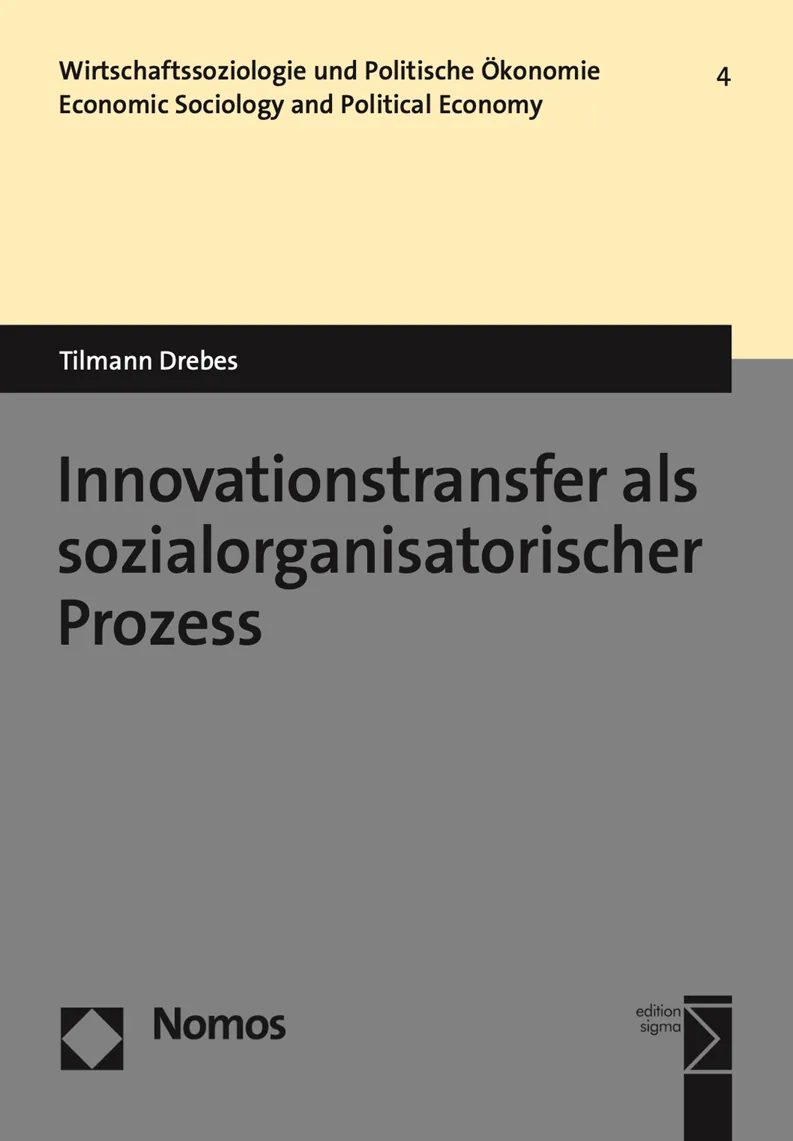
How does innovation truly succeed in organisations — and why does it so often fail? This question is at the heart of my empirical study. Over seven years, 70+ interviews and seven sites in the chemical industry, I examined how new ideas are transferred, adapted and embedded internally.
The result is a multidimensional model of innovation transfer:
I bring scientific insights into practice — in companies, universities and organisations that truly want to change.